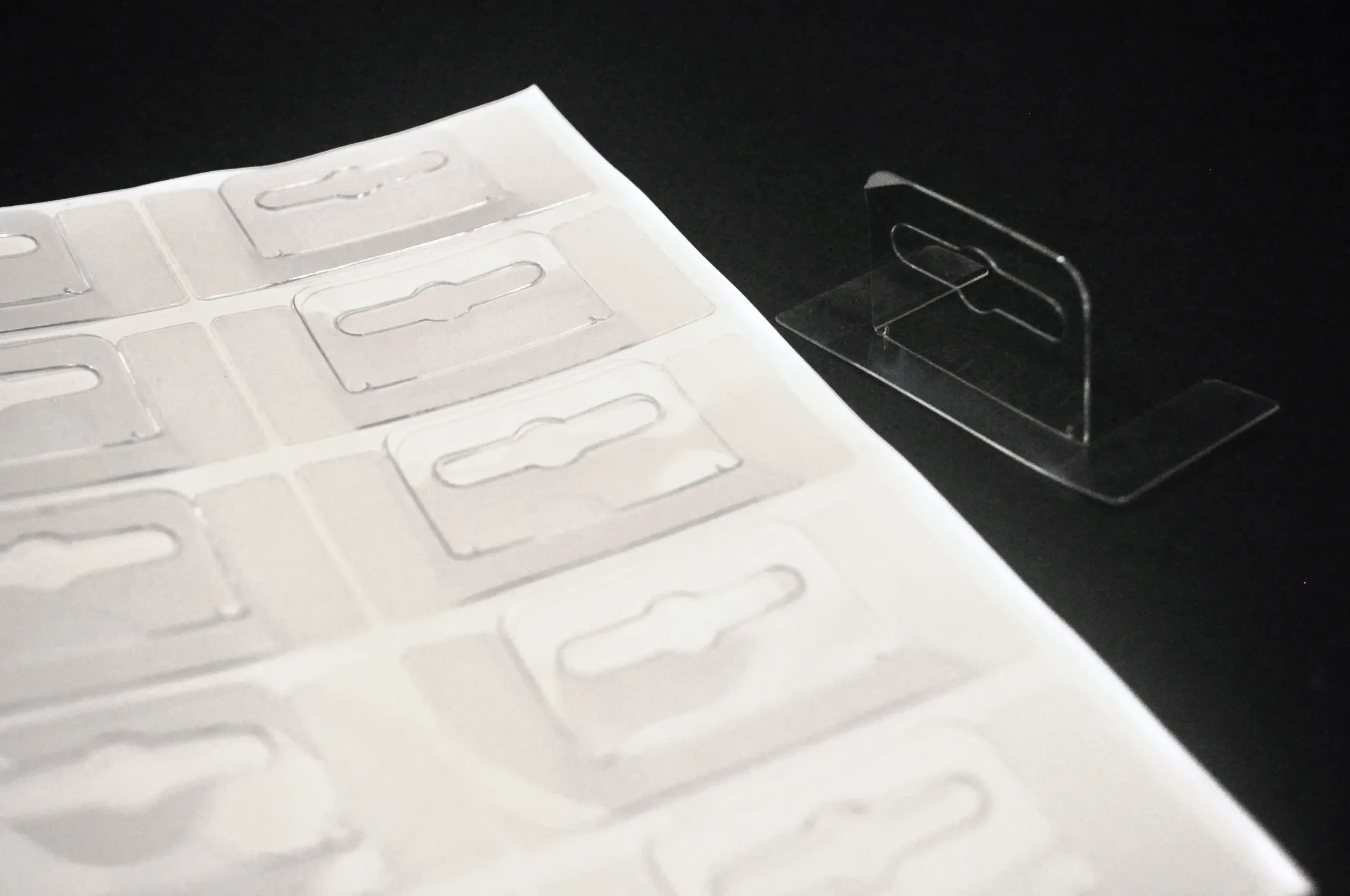

A self-adhesive hang tab may look like a simple packaging accessory. However, its performance depends on more than the material, thickness, or hole design of the tab itself.
The adhesive backing plays an equally important role.
In retail packaging applications, hang tabs are often applied within seconds and then move quickly into the next stages of packing, handling, shipping, or display. For this reason, an adhesive does not simply need to form a strong bond eventually.
An equally important question is :
How quickly can it grip the packaging surface immediately after application?
In adhesive technology, this property is known as “Tack”, or more specifically, “Initial Tack”.
For Best Stationery, the importance of initial tack became especially clear during a customer visit under unusually cold conditions.
Table of Contents
What Is Initial Tack?
Initial tack describes an adhesive’s ability to form an initial bond shortly after coming into contact with a surface under light pressure.
In simpler terms:
How quickly does the adhesive “grab” the surface when it is first applied?
An adhesive with higher initial tack can establish an immediate grip more quickly, helping the applied part remain in position instead of slipping, lifting, or shifting shortly after application.
For self-adhesive hang tabs, however, that first moment of contact is particularly important.
Why Does Tack Matter for Self-Adhesive Hang Tabs?
Self-adhesive hang tabs are designed to convert packages without hanging holes—such as cartons, pouches, flexible packs, and other retail packaging—into products that can be displayed on peg hooks.
The application process is intentionally simple:
Remove the release liner, position the hang tab, apply pressure, and the package is ready for hanging.
That simplicity is one of the key advantages of a self-adhesive hang tab.
If the tab requires an extended waiting period after application, or tends to shift or lift during the initial stage, it can interrupt subsequent packing and handling processes.
For B2B customers handling high-volume manual application, packaging assembly, or products that move quickly from application to packing and display, reliable initial tack can therefore contribute to a smoother and more efficient workflow.
What We Learned During an 8°C Customer Visit
Best Stationery’s self-adhesive hang tabs originally used an acrylic adhesive system.
During one customer visit to an export manufacturer in Miaoli, Taiwan, however, our team encountered an important real-world application issue.
A cold wave had brought the local temperature down to approximately 8°C (46°F).
Under those conditions, we observed that the acrylic adhesive then being used did not conform to the packaging surface as readily as it normally did, resulting in noticeably reduced initial tack during application.
The experience prompted us to look beyond one simple question—
“Will the adhesive ultimately hold?”
—and consider another one that can be just as important in an actual packaging operation:
“What happens at the exact moment the hang tab is applied?”
For self-adhesive products, those first few seconds can make a meaningful difference to the production process.
Why Does Application Temperature Matter?
Pressure-sensitive adhesives need sufficient contact with the substrate in order to develop an effective bond.
At lower temperatures, some adhesive formulations can become firmer and less able to conform quickly to the microscopic irregularities of a packaging surface. This may reduce the adhesive’s ability to establish an immediate bond.
As a result, an adhesive that performs well under normal room-temperature conditions may behave differently when it is first applied in a colder working environment.
For B2B packaging applications, adhesive selection should therefore consider more than just the final holding strength. Other important factors include:
- Packaging material
- Product weight
- Adhesive contact area
- Surface cleanliness and condition
- Actual application temperature
It is also important to distinguish application temperature from service temperature.
Application temperature refers to the conditions at the moment the adhesive is bonded to the surface. Service temperature refers to the temperatures the bonded product may encounter after a proper bond has already been established.
For a self-adhesive hang tab, our first priority during application is straightforward:
When the tab is pressed onto the package, it should grip the surface quickly and reliably.
Why Does Best Stationery Use Hot Melt Adhesive?
Based on our practical experience and product evaluation, Best Stationery subsequently adopted a hot melt pressure-sensitive adhesive for our self-adhesive hang tabs.
One of the key considerations is its strong initial tack performance.
For hang-tab applications, this allows the adhesive to establish a quick grip on suitable packaging surfaces under appropriate application conditions, helping reduce the possibility of movement, lifting, or shifting immediately after the tab is applied.
Certain hot melt pressure-sensitive adhesive formulations can also provide useful tack characteristics under lower-temperature application conditions, offering additional flexibility for customers operating in different markets and working environments.
That does not mean that one adhesive technology is universally superior to another.
Performance can vary significantly depending on adhesive formulation, substrate, surface condition, temperature, pressure, and the intended application.
For Best Stationery, choosing hot melt adhesive is therefore not simply a matter of deciding which adhesive is “stronger.”
It is about selecting an adhesive system that is better suited to the practical requirements of self-adhesive hang tabs—especially fast application and efficient retail-packaging workflows.
Even a Thin Layer of Adhesive Deserves Careful Attention
From the outside, a transparent self-adhesive hang tab may appear to be only a small packaging component.
Yet PET thickness, hanging-hole design, adhesive area, tab dimensions, and adhesive selection can all influence how the product performs in real-world applications.
At Best Stationery, product improvement does not always begin with a major design change or a new piece of equipment.
Sometimes, it begins with a customer visit, an unusually cold working environment, and one simple observation:
“Why isn’t the hang tab gripping as quickly as it normally does?”
Identifying issues in actual working environments and translating those observations into practical product improvements is an important part of how we continue to develop our self-adhesive solutions.
Today, Best Stationery offers a wide range of Self-Adhesive Hang Tabs, including Euro-hole, delta-hole, round-hole, flexible, foldable, J-hook, and paper-based designs for different packaging formats, product weights, and retail-display requirements.
For stationery brands, packaging suppliers, retail-display distributors, and product manufacturers, we also provide different specifications and customization options based on individual application requirements.
Because a reliable hanging display does not begin only when the product is placed on the hook—it begins at the moment the hang tab is applied.